25 May 2020

Initial Reports of Damage from Cyclone Amphan


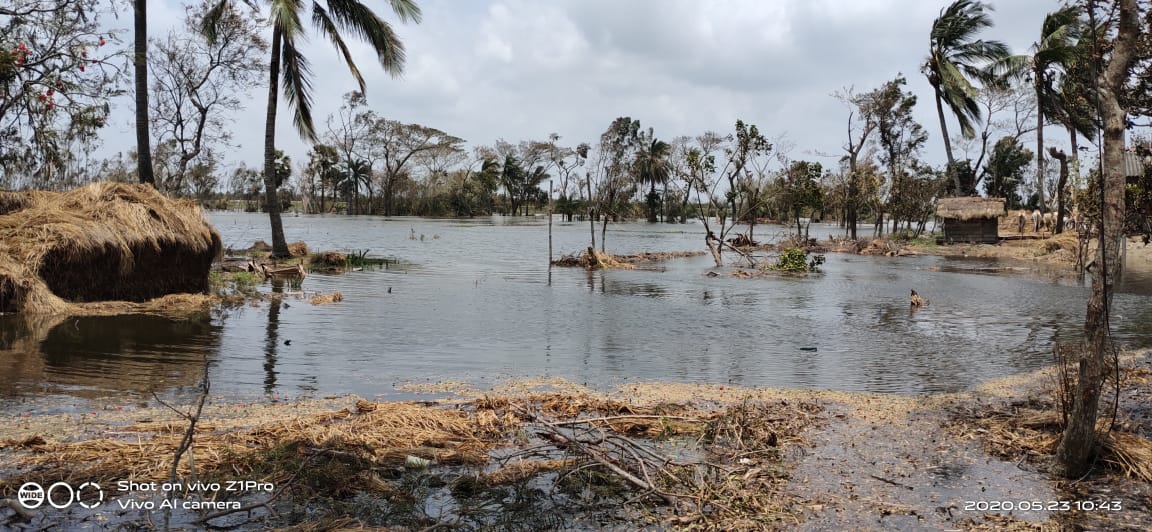
Preliminary reports have been trickling in from Pachimbanga Khetmajoor Samity (PBKMS) members of widespread damage and destruction. PBKMS has been organizing rural workers in the Sunderbans region of West Bengal for over 30 years now. We jumped into the fray as soon as the news of the trajectory of the cyclone was received, circulating helpline numbers and raising awareness about evacuation procedures, flood shelters and government guidelines. As the frightful storm progressed, however, phone lines went down. Vast areas of the affected regions of Bengal, including Kolkata and its adjoining suburbs are still without power. Our central office in Badu (Barasat) from where outreach and relief efforts are being coordinated has also been damaged by the cyclone. We are without electricity, water and phone connections.  Yesterday, we managed to get a preliminary picture of the extent of damage and destruction using intermittent network connections even as 70% of our members remain disconnected from the rest of the world. 

Fields are flooded with saline water which came gushing in when embankments broke. Even when some embankments managed to hold the surge, the storm surge raised the water many feet above the height of the embankments and water overflowed into low-lying islands.


Fish ponds form an integral part of a small farmer’s income in South and North 24 Parganas. Here, ponds are lined with fruit trees. Fish have died in village ponds either because of saline water flooding or rotting tree debris entering the water.


From all the reports we have gathered there are no reports of severe hunger yet.

Map of South Bengal showing the blocks in the two affected districts, South and North 2 Paraganas

The cyclone first made landfall in Sagar and Namkhana blocks. We have not been able to reach anyone in Sagar. PBKMS state committee member Khadeja Khatun is in Namkhana block. She called us for just a couple of minutes yesterday. There is no power and she is trying to preserve her battery. Networks come and go. She says after the storm entered, the concrete embankment broke at Fraserganj. Everything is flooded. 

As the storm moved north, in the islands that form Gosaba block to the east of Sagar and Namkhana, there are remote island villages such as Kumirmari and Satjeliya where a large number of houses, unlike in the rest of the Sunderbans, are still constructed from mud. These kaccha houses have all been severely damaged by the wind, heavy rains and flood waters. Ashok Mandal in Satjeliya says that luckily no embankments were breached in his gram panchayat but concrete embankments have broken in Bali-2 and Bipradaspur. 
House damaged by the wind in Chotamollakhali, Kalidaspur
 Just north of Gosaba, in Basanti block, Alok Das a marginal farmer who also owns a small shop says that with the flooding of farmland and contamination of fish ponds almost 4500 families of the 6500 in his gram panchayat, Jharkhali, are devastated. 9 out of 10 houses have been destroyed. There is not a single house with the asbestos, tin or tile roof left standing. The gale force winds have taken all the roofs flying with them and just the walls of the houses remain. 

The breach of concrete embankments, that were built specially saying they would be more resilient after the devastation of Cyclone Aila in 2009 is everywhere says Kanai Haldar, state committee member who is coordinating PBKMS efforts throughout the region. Kanai says, “we are constantly playing catch up with the embankments, they are destroyed on one side, we rebuild and then they break on another side. Saline water constantly corrodes the bricks. Many of these houses with the tin and tile roofs are houses that were paid for by the government housing assistance scheme, Indira Awaas Yojana (or now Pradhan Mantri Awas Yojana (Gramin)) but these roofs are in no way suitable for the climatic conditions we face with tropical storms and cyclones.” 


Broken houses in Mathurapur-2


North of Namkhana and Sagar, is Patharpratima. We have not been able to reach people in any of the island villages there.

Further north in Mathurapur-2, in Nagendrapur, PBKMS member Ruhit Mondal reports that embankments have been breached in Domkal Chatterjeepara while in Bhangarkhal the storm surge crossed the embankment and flooded the island. In Kankandighi, brick embankments broke in 3 different places. The PBKMS field center in Raidighi has been completely destroyed and PBKMS activist Namita Halder had to find shelter for the night of the storm.  

In Kultali, PBKMS members Purnachandra Sith and Deepak Mondal reported embankment breaches in 5 panchayats; Moipith, Bhubaneshwari, Deulbari-Debipur, Kaikhali, and Purba Gurguria. Purnchandra Sith says that a strange thing happened with the rain this time that he has not seen before. In his village of Baikunthapur in Moipith the leaves of all the vegetation have turned black and so did the pond waters. Maya Das, member of a self help group, told us that there were no broken embankments in Gopalganj G.P. but a lot of wind damage. 

School submerged in Bhubaneshwari, Kultali

Flooding in Kultali

Flooding in Kultali

Flooding in Kultali

Flooding in Kultali


Wind damage is extensive in Mathurapur-1 too where there was no flooding. Jaynagar 2 to the east though is next to a river and saw flooding by saline water by storm surges that overflowed over embankments.

In North 24 Parganas, we have not been able to get in touch with activists in Hingalganj, Sandeshkhali-1 and Minakhan. Barun Das in Sandeshkhali-2 reported embankment breaches in Atapur and extensive damage to houses in Durgamandap.  PBKMS North 24 Paraganas center in Hasnabad has broken because of the winds during the cyclone. The activists in the center Suchitra Mondal and Swapan Haldar have no way to charge their phones and are preserving their battery for emergencies. Today, we spoke to them briefly. They said they had only managed to contact people only in 3 or 4 villages but the widespread damage to homes and fields is clear. They are calling an emergency meeting on Tuesday after Eid and will begin relief distribution immediately after. 

Homes broken in Durgamandap, Sandeshkhali-2


PBKMS has immediately turned its focus to relief work in 4 blocks of North 24 Parganas (Hasnabad, Minakha, Sandeshkhali 1 and Sandeshkhali 2) and 9 blocks of South 24 Parganas (Basanti, Gosaba, Joynagar 2, Kultali, Mathurapur 1, Mathurapur 2, Namkhana, Patharpratima and Sagar). Immediate relief work involves:
  • Providing chlorine and bleaching powder to clean waters sources and surroundings in 263 villages 
  •  Providing water purification tablets for 27,000 families in 263 villages to ensure that they have safe drinking water
  • Providing Tarpaulin sheets to community members for 13,500 families with badly damaged houses
Once immediate relief is complete, PBKMS will work with marginal farmers to reclaim their land from saline water encroachment and then provide saline-resistant paddy seeds. Agricultural training on use of the plant and seeds will be provided to 2,700 farmers in partnership with the Save the Rice campaign. 


What will this Eid be like for Hasnabanu Laskar surveying the devastation to her home and lands after Amphan in Deulbari, Kultali?

***Compiled using phone updates from PBKMS activists by Aahana Ganguly (volunteer) and Kanai Haldar (state committee member) 


20 May 2017

Right to Food Campaign Rejects Cuts To Maternity Benefits In Food Act


The Right to Food Campaign expresses deep disappointment over the truncated Maternity Benefits Programme (MBP) that was approved by the Cabinet yesterday. Maternity benefits of at least Rs. 6000 for all pregnant and lactating women (except those working in government/public sector undertakings) have been a legal entitlement for almost four years now, guaranteed under the National Food Security Act (NFSA, 2013).  

Despite this, there was no scheme formulated to deliver this entitlement by the central government. Only the Indira Gandhi Matritva Sahyog Yojana (IGMSY) a pilot scheme in 53 districts continued to be implemented. The Prime Minister in his speech on December 31st announced expansion of maternity benefits to all districts without making any reference to the NFSA. Since then there have been indications that there will be a number of exclusions, a fear expressed by the RTFC as well in response to the underfunding of the scheme as reflected in the annual budget.  

The cabinet approved MBP goes against the letter and spirit of the NFSA. Firstly, it is restricted to only the first birth. There is no justification for this other than keeping the financial obligations to the minimum. All conditionalities attached to the current IGMSY scheme such as two child norm and age of marriage have been shown to be fundamentally discriminatory to both women and children affecting the most marginalised and vulnerable women large from socially discriminated communities such as SC, ST and minorities putting their lives to risk. In the process of universalisation rather than withdrawing all conditionalities from IGMSY, the new scheme makes it even more restrictive.  

In another unwarranted move, the MBP has also been linked to institutional deliveries, possibly to further reduce the funds allocated, and therefore merged with the Janani Suraksha Yojana (JSY). The JSY is an older scheme that was started with an entirely different purpose which was to incentivise institutional deliveries whereas the MBP is intended to provide wage compensation, just as it does in the formal sector and has been included in the NFSA as a minimum of Rs 6000 for that purpose alone. Based on data from the latest National Family Health Survey, 21% of children born at home are already ineligible for JSY.

The Maternity Benefits Act (MBA) was recently amended to expand the maternity leave from 17 weeks to 26 weeks. While this was a welcome move, the MBA covers only about 18 lakh women in the organised sector whereas over 2.7 crore deliveries take place in India each year. The maternity benefits act does not include in its ambit more than 95% of women in the country who are in the informal sector. When the requirement of six months of paid leave has been accepted for women in the formal sector (public and private), it is unacceptable that a wage compensation of less than half of minimum wages, that too only for one birth should be the norm for the rest of the women in the country. In fact, the modest maternity entitlements under MBP are barely equivalent to five weeks of minimum wages in Bihar [compared to the more than 6 months of paid leave offered in the formal sector]. Such meagre wage compensation in light of the amendment to the Maternity Benefit Act, would in fact amount to discrimination and inequality of law under article 14 of the constitution.

The campaign demands universal, unconditional maternity entitlements equivalent to wages for a minimum of six months at no less than the prevailing minimum wages. Maternity entitlements must be seen as a right for all women and also as wage compensation for those in the unorganised sector.

19 May 2017

Bhangar: Press Conference Invitation

In a shocking situation in West Bengal, where the TMC and their Chief Minister, Mamata Banerjee came to power on the back of struggles against forcible land acquisition, the ruling party has unleashed unprecedented repression on a movement in Bhangur against similar forcible land acquisition. People of the villages Khamarait, Machhibhanga, Tona, Gazipur etc. in Polerhat 2 No. Panchayat in Bhangar Assembly Constituency, South 24 Parganas, West Bengal are facing desperate situation due to the Government decision to situate a Power Grid (440/220 KV) in that area.

Two people have been killed in police firing, 33 people are in jail, over 40 people have been charged with terror charges under UAPA, and almost the entire population of about 20 villages (men, children and women) have been charged with a number of falsely fabricated non-bailable offences, including eminent activists working for justice through a West Bengal level solidarity committee. An unofficial economic blockade has been declared with any person leaving the village being arrested. Despite repeatedly asking for dialogue, the Government is refusing to talk to the affected people.

In order to bring national attention to this struggle, we are organising a press conference on the on 5th May 2017 at 1.30 PM at the Women’s Press Corps office, 5 Windsor Place, New Delhi 110001.

The people addressing the press conference are Justice RajinderSachar, former Chief Justice Delhi High Court, KN Ramachandran, General Secretary, CPI(ML) Red Star, Dipankar Bhattacharya General secretary CPI(ML) Liberation, Anuradha Talwar, representative of Bhangur Andolan Sanhati (Solidarity) Committee, Achin Vanaik , writer and academic , Amit of Majdur Kranti Parishad,Sanjay Parikh, Supreme Court counsel and PUCL vice president, Bittu Convenor WSS, and Kavita Srivastava, People’s Union of Civil Liberties.

Thousands March For Right To Food

Undaunted by the heat and the sun, with temperatures reaching 400C, members of the Right to Food and Work Campaign-West Bengal reached Kolkata on April 27 for a deputation to the Food and Supplies Department. Those participating came from the Himalayan foothills of North Bengal, the islands of the Sunderbans, the burning red laterite soil of western West Bengal, the areas bordering Bangladesh and the green plains surrounding the Hooghly. Those in the processions ranged from sex workers to midday meal cooks, agricultural workers to van rickshaw pullers, housewives to members of self-help groups, domestic servants to tea garden workers etc. 


This huge group of over 5,000 people from 16 districts of the State, along with the urban poor of Kolkata, sent a delegation that met the Secretary Food and Supplies Department, Mr Durga Das Goswami and Joint Secretary and Nodal Officer (for the National Food Security Act), Mr Shubra Chakraborty. Their response was as follows:

Measures would be taken by the Department to segregate Government and tea management rations so that the management does not cheat tea garden workers by replacing its food grain component of wages-in-kind with Government rations.

The Department was already considering the Campaign’s demands to give wheat instead of bad quality atta. It was also in the process of issuing a circular to ensure that the five different types of cards are not used unfairly and to stop many poor families being enlisted as RKSY 2 and many better off families being given Antodaya cards. 

The delegation was assured that Vigilance and Monitoring Committees would be formed and made functional soon and representation from Campaign members in these committees would also be ensured.

The officials said that allotment copies of the amount of food grains transferred to each ration dealer would be provided to the members of the campaign. For this purpose, the delegation was asked to give a list of names with phone numbers in every block to whom they would give the allotment copy. Also the SMS system to provide ration card holders with information about their allotments would be re-started.

Issues such as universalization of the rationing system, formation of the Food Commission, bringing all food schemes under the Food Security Rules and providing all ration card holders with 14kgs of food grains, 1.5 kg pulses, 800 ml edible oil and 1 litre kerosene oil at subsidized prices were policy issues which they would forward to their superiors.

While the Department felt that the PoS machine could be used to stop corruption, they agreed to look at the Campaign’s experience in other states and to see that PoS machines and Aadhar cards do not become a means of exclusion.

The delegation was assured that on giving specific experiences, all food grains due to beneficiaries from their past quotas in the rationing system would be immediately disbursed to the beneficiaries;


The participants from 17 districts came to the Subodh Mullick Square in two rallies from Howrah Station, and Sealdah station. Throughout the rallies their main slogan was “Work in every hand and Food in every plate”, interspersed with songs and dances. 

While the original intention was to go to Khadya Bhawan itself, the police stopped the rallies at SM Square, where many participants made speeches in support of the demands while a delegation of 7 people met the Minister’s representatives.

Amongst the participating organisations, who are all members of the Campaign, were Paschim Banga Khet Majoor Samity, Shramajeevi Mahila Samity, Udayani Social Action Forum’s self help group members, TUCC, Swayam’s Nari Suraksha committees, Durbar Disha Griha Paricharika Union, Durbar Mahila Samanvay Committee, BMCDM etc.
        
RIGHT TO FOOD AND WORK CAMPAIGN
JANA SANGHATI KENDRA,1 Shibtala Road,Maheswarpur, Badu, Kolkata 700128