A team led by senior activists of the union met people who will face the brunt of the proposed open cast coal mine in Deucha Pachami, Birbhum
PBKMS (Paschim Banga Khet Majoor Samity) visited a few villages located in the proposed project site of the upcoming Deucha Pachami coal mines in the district of Birbhum in West Bengal. A small team led by our senior activist and treasurer, Comrade Kanai Halder visited a few villages in the Mohammadbazar block to interact with the community members who face the threat of eviction. Our visit was facilitated by one of the civil society organizations in the region named PAPA (Project Affected People's Association) which is working amongst the tribal community.
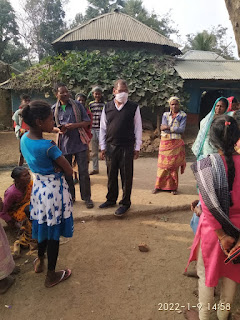
14 villages will be severely affected post commencement of the coal mining project. We came to know of a protest march, in which the community members displayed brooms, symbolizing their desire of chasing away the 'dikus' (outsiders) who are eyeing the natural resources of the area. The march was held by the residents of the Dewanganj village and the police administration immediately cracked down on them with the temporary detention of a local community mobilizer.
The population density of the area is less with the number of households in a village seldom crossing twenty-five. This is mainly due to the topography of the area, marked by jungles and hillocks. The implementation of rights-based legislation(s) in the area is poor, to say the least. Villagers do not have access to the public works programme, which guarantees a minimum of 100 days of paid work to each and every rural household in the country. Many households have stopped receiving their entitled food grains through the Public Distribution System. Anganwadi centres are not functioning properly and other schemes like mission Nirmal Bangla, Bangla Awas Yojana, etc are also not being implemented in their true spirits. Without paying a hefty kickback, the central schemes are also not made accessible to the people.
A certain fear has crept into the minds of the villagers in accessing benefits of state-sponsored schemes for they feel that on the pretext of filling up of forms, the administration will manipulate them to part with their homestead and agricultural land(s). For similar reasons, we have been prevented from taking photographs or even writing field notes in some areas. The suspicion on the administration has grown to such an extent!
The electricity connection is not too stable and often villages go without electricity for a long period of time. The villages of Gabarbathan and Sagarbandi are yet to receive electricity connections. Some of the villages have electric poles but the households have not been reached with proper connections. Notable amongst them are Harisingh, Talbandh, Khetpahari and Baromesya.
The residents of the region mainly communicate in Alchiki, Oraon and Santali languages. We have worked in Birbhum briefly from 1994-96 and Com. Akal Mandi from this region was even an active member of our then state committee. In the anchals of Dewanganj and Hinglo, we met people who are not in favour of the coal mine being commissioned but have also come across a section of the community who feel that the mine project will benefit them economically. Though, the people do not trust the committee formed by the administration to do full justice to their legitimate claims.
A significant number of the residents are not keen to give up their homestead and agricultural lands for the sake of a coal mine. The landless population are in favour of evaluating the full compensation package before taking a final decision. Representatives of mainstream political parties often visit the villages which have been proposed to be included in the coal mine project with the objective of mobilizing people to further the aspirations of the concerned political party. The people have experienced that such interactions do not benefit them in any manner and expose them to harassment meted out by the administration who are always on their toes to snuff out any opposition to their unilateral decisions. People from the anchals of Dewanganj and Sagarbandi are leading the protests against the administration which attempts to complete the land acquisition soon. The cadres of the ruling political party in the state are also not being allowed in these areas. Community mobilizers are planning to hold a meeting with the heads of the fourteen villages to chalk out a joint resistance strategy, involving democratic means of protests.
PBKMS will also plan the nature of its intervention in association with the affected communities. Birbhum and particularly the villages which are falling under the area of the proposed coal mine happened to be our field area in the mid-90s. We plan to strengthen our organization over there along with active participation in the movement to ensure the ownership of the tribal community over jal, jangal and jamin. The administration has virtually halted all the projects pertaining to the development of social infrastructure with the hope of tiring out the communities in accessing public goods as well as basic necessities.
All the conversations took place in the Alchiki language and we are thankful to our sathi Com. Somnath Baske, for helping us in having multiple conversations with the native speakers. The report has been prepared after translating the main subjects of the conversations into Bengali and noting them down during our return journey to Kolkata.


