
Women carrying our trade union flags during the march

A woman carrying her daughter throughout the march, demanding safety for herself and her child, at home and outside


Names of the
deceased: Smt Jyotsna Gorai (61 years) and Shri Jhantu Gorai (36 years)
Smt. Jyotsna Gorai
and Shri Jhantu Gorai, residing in Puncha Gram Panchayat of Puncha block in
Purulia have died on 18th October, 2020 and 28th October,
2020 respectively out of their inability to access food for a considerable
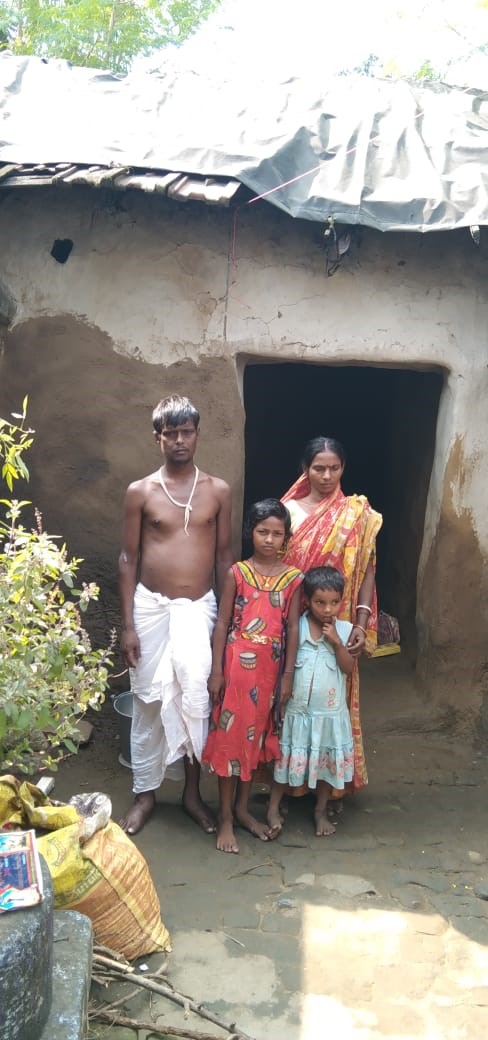
period of time. A widow, Smt. Jyotsna Gorai was staying with the family of his
younger son (Shri Jhantu Gorai) in a dilapidated dwelling unit which in turn
was built by her maternal family. The family consisted of the deceased
individuals, wife of Shri Jhantu Gorai and their two girl children aged seven
and four years respectively. Being landless agricultural labourers, the family of
five was at a considerable disadvantage in having access to basic necessities. The
son is a specially-abled individual which restricted his ability to contribute
to the household income. A PHH (Priority Household) ration card and a job card
of NREGA (public works programme implemented according to the MGNREGA, 2005) were
found to be possessed by the family. Though the absence of a bank account,
virtually made them unable to access the latter programme. Smt Tuktuki Gorai,
the daughter-in-law was the only earning member and even she was not able to
work for long hours due to general weakness. The lady used to work as a cook in
the Mid Day Meal programme and due to closure of educational institutions in
the state on account of COVID-19 restrictions, she has not been able to earn
her wages. The lady was found to be frail and emaciated. She has not been able
to earn a daily wage of more than ₹50 on days where she has been able to work
in the nearby agricultural fields.
Smt. Jyotsna Gorai
fell seriously ill around five months ago and the family was not able to get
her treated at any medical facility. The nationwide lockdown and the sudden
loss of opportunities to participate in any unskilled work had a negative
impact on the household. Food grains received through the PDS (Public
Distribution System) were inadequate and with the fall in household income, the
landless family also failed to gain access to other necessary food items. The
morning breakfast consisted of a ‘chapati’ and black tea. Boiled rice and
potatoes were the usual food items available for lunch and the family
reportedly did not have enough food to prepare a dinner on most of the days. The
household income was virtually nil for a period of four long months. Closing
down of the ‘anganwadi’ centres and the intermittent supply of dry rations to
eligible beneficiaries also imposed further constraints on the household to meet
their daily food requirements. The panchayat pradhan, block sabhapati and the
Block Development Officer of Puncha were approached by the family for possible
help in accessing adequate food. The family even went to the local police
station for help. Only a civic police volunteer visited the family once and
food ration(s) or food kits were neither provided by the civil nor by the
police administration.
Smt. Jyotsna Gorai’s health condition deteriorated with acute pain in the abdominal region along with cramps. She was taken to the Puncha Block Primary Health Centre and further referred to the Bankura Medical College and Hospital after a preliminary diagnosis. Unfortunately, she was refused treatment at the Bankura district hospital citing Covid-19 protocols. The maternal family of the woman tried to take her to a medical facility in Ranchi (Jharkhand) on being refused treatment and any assistance in facilitating her admission to any other government run facility. She breathed her last in Ranchi on 18th October, 2020. In the meanwhile, Shri Jhantu Gorai’s condition started to deteriorate and he complained about severe stomach ache on 26th October, 2020 along with swelling in his abdomen. He was taken to the Puncha Block Primary Health Centre on the next day and breathed his last on 28th October, 2020.
Vulnerability Profiling: Purulia is home to a
predominantly rural population, with a significant scheduled tribe and
scheduled caste population. Around 45% of the population are not literate with
more than half of the population dependent on manual casual labour[1]. The
extreme vulnerability of a household residing in one of the rural parts of the
district with no land holdings or any other durable assets is evident from such
a profile. Purulia also happens to be one of the districts of the ‘Jangalmahal’
area (a region with considerable forest cover which was affected by left wing
extremism) where the implementation of vital rights based legislations has not
been in their true spirits to say the least.
Lack of access
to a bank account and any other social security schemes (particularly the old
age pension and disability pension schemes) point towards the exclusion of the
household and the violation of their constitutional right to an exploitation –
free, dignified life. Lack of access to quality healthcare and the denial of
treatment in a district medical hospital highlight the vulnerability of the
family, in addition to being a violation of article 21 of the Indian
constitution.
The family does
not fulfil even one criterion for automatic exclusion of households according to
the laid down guidelines of the SECC, 2011. Further, the nature of their
dwelling unit and other factors warrant their identification as a deprived
household, fulfilling three conditions of deprivation out of seven. The
conditions of deprivation fulfilled by the household have been identified to be
as follows:
1. Households
without a ‘pucca’ roof
2. Households
without a literate adult above the age of 25
3. Landless
households deriving a major part of their income from manual labour
With the death of Shri Jhantu Gorai, the household has further slipped in the deprivation index and the criterion of a household being a female headed one, with no adult male member between 16 and 59 years of age gets added onto the existing list of ‘conditions of deprivation’.

Our immediate demands from the administration:
The following
measures should be taken immediately by the block and district administrations
to support the household in confronting challenges owing its socio-economic
condition:
·
Releasing GR (General Ration) for the household
·
A comprehensive medical checkup of Smt Tuktuki Gorai
and her children with access to nutritional supplements
·
Upgrading the existing PHH (Priority Household) ration
card to that of a AAY (Antyodaya Anna Yojana) ration card
·
Facilitating the opening of a ‘Jan Dhan’ bank account
in the name of Smt Tuktuki Ghorai, the widow of Shri Jhantu Gorai
·
Extending benefits of the West Bengal Widow Pension
Scheme, 2010 to Smt Tuktuki Ghorai
·
Enrolment of the household under the Pradhan Mantri
Awas Yojana- Gramin to address the need of a ‘pucca’ dwelling unit
·
Facilitating the access to unskilled work through
MGNREGA, 2005 for Smt Tuktuki Gorai and allotment of work sites wherein crèches
will be made available. This will enable her girl children to have access to a
safe environment during the working hours of their mother.
The members of Shramajivee Mahila Samity have started a signature campaign to bring to the administration’s notice the rampant selling of illegal liquor in various parts of the state; the brunt of which is often borne by the women and children. Incidents of domestic violence, sexual abuse, harassment in public spaces, rising alcoholism amongst the youth, stress on household budget due to non-discretionary spending on alcohol and degradation of familial ties are some of the ill effects that women and the youth have to regularly face.


The following demands are being made, requesting the administration’s immediate intervention:
1. Action must be taken to close down all unlicensed illegal liquor outlets.
2. No further licenses should be provided to liquor outlets.
3. All illegal liquor outlets selling alcohol within a radius of 100 metres of educational institutions, government offices, places of worship and other public places must be shut.
4. Dependence of the state government on liquor revenues should be reduced and the Central Govt should compensate for the same.
5. Non-partisan action by police, particularly regarding cases of violence against women.

The letter in Bengali to be submitted to the block as well as district administrations
Tea garden workers are successfully and very efficiently running tea gardens themselves after management abandoned them. Paschim Banga Khet Majoor Samity took steps in Madhu, Birpara and Raipur tea gardens by setting up and supporting collective groups to run the tea gardens after the management abandoned these tea gardens. The tea garden workers were devastated after the management abandoned these gardens as the tea garden workers were completely dependent on tea gardens for their survival. These tea gardens are now running successfully by the collectives and even saving a surplus amount.


PBKMS is now exploring the possibility of making and selling
hand made tea in Madhu and Birpara, so as to ensure value added and higher
incomes for the workers.
